
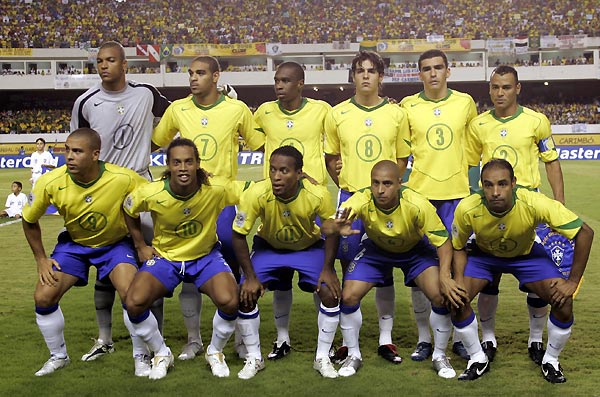

The first match of the Brazil national football team is generally considered to be a 1916 match between a Rio and São Paulo select team and the English club Exeter City F.C., which the Brazilian team won 2–0.[2] In contrast to future successes, the nation's early appearances were far from brilliant, partly due to internal strife within Brazilian football over professionalism, which rendered the Brazilian Football Confederation unable to field full-strength teams.
n particular, disputes between the São Paulo and Rio de Janeiro state football federations meant that the team would not be composed of players coming from either of the federations. In both the 1930 and 1934 tournaments, Brazil were knocked out at the very first stage. But 1938 was a sign of things to come, as Brazil finished a strong third, with Leonidas da Silva making history and being the first player to score four goals in a World Cup match.
Brazil hosted the 1950 FIFA World Cup which was the first tournament to be held after World War II. It is the only time Brazil has hosted the tournament to date. The 1950 tournament was unique in not having a single final, but rather a final round-robin stage of four teams; however, to all intents and purposes the deciding game between Brazil and Uruguay acted as that tournament's "final". The match was hosted at the Maracanã stadium in Rio de Janeiro, watched by 199,854 people, and Brazil only needed a draw to win, but lost the match 2-1 after being 1-0 up; this match has since been known in South America as "Maracanazo". In Brazil it is called "Final Fatídica" ("fateful final").[3]
For the 1954 FIFA World Cup, in Switzerland, the Brazilian team was almost completely renovated, so as to forget the Maracanã defeat, but still had a group of good players, including Nílton Santos, Djalma Santos, and Didi. Brazil didn't go very far though. The quarterfinals saw the favorites Hungary beat Brazil 4-2 in one of the ugliest matches in football history, which would become infamous as the Battle of Berne.
Brazil's coach, Vicente Feola imposed strict rules on the squad for the 1958 FIFA World Cup, held in Sweden. The players were given a list of forty things that they were not allowed to do, including wearing hats or umbrellas, smoking while wearing official clothing and talking to the press outside of allocated times. They were the only team to bring a psychologist (because the memories of 1950 still affected some players) or a dentist (for, because of their humble origins, many players had dental problems, which caused infections and also had negative impact on performance) with them, and had sent a representative to Europe to watch the qualifying matches a year before the tournament began.
Brazil were drawn in the toughest group, with England, the USSR and Austria. They beat Austria 3–0 in their first match, then drew 0–0 with England. The Brazilians had been worried about their match with the USSR who had exceptional fitness and were one of the favourites to win the tournament; their strategy was to take risks at the beginning of the match to try and score an early goal. Before the match, the leaders of the team, Bellini, Nílton Santos, and Didi, spoke to coach Vicente Feola and persuaded him to make three substitutions which were crucial for Brazil to defeat the Soviets and win the Cup: Zito, Garrincha, and Pelé would start playing against the USSR. From the kick off, they passed the ball to Garrincha who beat three players before hitting the post with a shot. They kept up the pressure relentlessly, and after three minutes which were later described as "the greatest three minutes in the history of football",[4]Wales, and they beat France 5–2 in the semi-final. Brazil beat the hosts Sweden, in the final 5-2, winning their first World Cup and becoming the first nation to win a World Cup title outside of its own continent. A celebrated fact was that Feola would sometimes take naps during training sessions and would sometimes close his eyes during matches, giving the impression that he was asleep. Because of this, Didi was sometimes said to be the real coach of the team, as he commanded the mid-field. Vavá gave Brazil the lead. They won the match 2–0. Pelé scored the only goal of their quarter-final match against
In the 1962 FIFA World Cup, Brazil got its second title with Garrincha as the star player; a mantle and responsibility bestowed upon him after regular talisman, Pelé, was injured during the first group match against Mexico and unable to play for the rest of the tournament.
In the 1966 FIFA World Cup, the preparation of the team was affected by political influences. All the major Brazilian clubs wanted their players included in the Brazilian team, to give them more exposure. In the final months of preparation, the coach Vicente Feola was working with 46 players, of which only 22 would go to England; this caused lots of internal dispute and psychological pressure. The result was that, in 1966, Brazil had their worst performance in all World Cups. Of course, another perhaps bigger issue, was that Pelé (who may have been at the height of his career) was chopped at seemingly every opportunity in the group matches.
Brazil won its third World Cup in Mexico in the 1970 FIFA World Cup. Brazil fielded what has been considered to be the best football squad ever, led by Pelé in his last World Cup final, captain Carlos Alberto, Jairzinho, Tostão, Gérson and Rivelino. After winning the Jules Rimet Trophy for the third time Brazil were allowed to keep it for good.
Galatasaray Spor Kulübü (in English: Galatasaray Sports Club) or Galatasaray SK is a Turkish sports club based in Istanbul which is famous for its football section; Galatasaray is the most successful Turkish club in history. Galatasaray S.K. is the most successful club in the history of Turkish football, having won more trophies than any other Turkish club.[1]Founded in 1905 by Ali Sami Yen and his fellows from the prestigious Galatasaray High School, Galatasaray currently has 16 Turkish league championships, and also won the UEFA Cup and UEFA Super Cup in 2000. Galatasaray also topped the world club ranking to be named "Best Football Club in the World" in January of 2001.[2]
Galatasaray is one of only two teams to have won the UEFA Cup without being beaten in a single match and is also the first team to win the competition after finishing third place in the Champions League group stage. In winning the UEFA Cup during the 1999-2000 season, beating Arsenal of England on penalties, Galatasaray became the first Turkish football club ever to win a European trophy. Galatasaray also holds the world record of most games won in a row at home (25 games in a row: 13 May 2001 - 8 December 2002).
Galatasaray was founded in the autumn of 1905 by Galatasaray Lisesi students as a footballAli Sami Yen. Their first match was against Kadıköy Faure School and they won this match 2-0.[3] There were discussions about the club's name, in which some suggested Gloria (victory) and others Audace (courage), but it was decided that its name would be Galatasaray.[4] club. Galatasaray's first president was
According to researcher Cem Atabeyoğlu, Galatasaray took its name from one of its first matches. In that match, Galatasaray won 2-0 over Rûm club and the spectators called them "Galata Sarayı efendileri" (in English: Gentlemen of Galata Palace), and, after this event, they adopted that name and started to call their club "Galata Sarayı". In 1905, during the era of the Ottoman Empire, there weren't any laws for associations so the club couldn't be registered officially, but, after the 1912 Law of Association, the club registered legally.[5]
| “ | Our aim is to play together like Englishmen, to have a color and a name and to beat the non - Turkish teams. | ” |
This was how the first Turkish football club was founded. Among with the founder Ali Sami Yen, the co-founders were the ones who were keen to do this sport, such as Asim Tevfik Sonumut, Reşat Şirvani, Cevdet Kalpakçıoğlu, Abidin Daver and Kamil.
At first, the colors of the Galatasaray Sports Club were red and white. These are the colors in Turkish flag. However, Turkish Republic wasn't founded at that time. Therefore, this inspiration caused repressive administration of the day feel uncomfortable and the administration hounded the footballers. For this reason, the colors were changed.
New colors were chosen as red and yellow. Ali Sami Yen stated, "We were imagining brightness of yellow - red fire over our team and thinking that it would carry us from one victory to another."[5] It eventually did.
Since there weren't any Turkish teams, Galatasaray joined the Istanbul League that was consisting of English and Greek teams in the season of 1905-1906. With their first championship title they won in 1907-1908, they heralded the beginning of Turkish football history.[6]
While the football in Turkey began to fully develop, Galatasaray won ten more Istanbul LeagueSunday League titles and three Friday League titles until 1952. Upon recognition of professional football in 1952, the first professional but nonnational league of Turkey, Istanbul Professional League played between 1952-1959. Galatasaray won three of these seven titles. titles, six
Türkiye Profesyonel 1. Ligi (today it is organized with the name Turkcell Super League) formed in 1959. This is the top-flight professional league in Turkish nationwide football, and the most popular sporting competition in the country. Galatasaray joined all seasons and won 16 league titles since then.[7]
The Turkish Football Federation starts to organize "Turkish Cup" (today it is organized with the name Fortis Turkey Cup) in the 1962-63 season for Turkish clubs to qualify for the UEFA[8] competitions. This is the only national cup competition in Turkey. Galatasaray joined all seasons and won 14 trophies since then.
Probably the greatest record that club holds is winning national championships in 13 different sport branches in 1986-87 season.
Galatasaray's most successful era came in late 1990s, when the club won the UEFA Cup and European Super Cup and becoming the first Turkish football club ever to win an European trophy. They were aided in this by one of Turkey's best generation of home grown footballers who went on to finish third in the 2002 FIFA World Cup and played quarter finals of UEFA Euro 2000. Besides the talented players, visiting teams also disliked travelling into Ali Sami Yen Stadium which is literally called "Hell" by the supporters of Galatasaray due to the intimidating atmosphere provided by the fans including chants and riots in the crowds. [9]
Galatasaray is the only team to have won the Turkish League title, the Turkish Cup, the UEFA Cup and the UEFA Super Cup in the same season. Galatasaray holds the record of winning four consecutive Turkish league titles, which all of these came under the coaching of Fatih Terim and the visionary club president Faruk Süren.
There are many successful footballers played for Galatasaray and made their mark on Turkish football history. Few examples may be 1930's national hero Eşfak Aykoç[10], Boduri who tragically died in age of 21[11], Mehmet Leblebi who scored a domestic record of 14 goals in a match[12], Gündüz Kılıç nicknamed Baba (father) who was the coach but also the player of his team in 1950's with great success on both[13], Bülent-Reha Eken brothers, Suat Mamat who made a hat-trick in 1954 World Cup[14], Coşkun Özarı a life devoted to Galatasaray[15], Turgay Şeren the heroic goalkeeper that called "the Panther of Berlin"[16], Fatih Terim the team captain of Galatasaray and Turkish National Football team for years and the current coach[17], Metin Oktay the legendery six time top scorer of Turkish league[18], Zoran Simović another skilled goalkeeper known for his penalty saves[19], Cüneyt Tanman played a record of 342 games for Galatasaray[20], Tanju Çolak extraordinary goalscorer and European Golden Boot1988 winner with Galatasaray[21], Cevad Prekazi an Albanian teammate of Tanju specializing in free kicks[22], Taffarel the world cup winner goalkeeper of Brazil[23], Gheorghe Hagi Romanian football hero that still described as the best foreign player ever to play in Turkey[24], and last but not least, Hakan Şükür, the player who scored most goals in the first division of Turkish football history (242 goals) and still scoring.


